Submit Article
Template
TEMPLATE
Information
- For Readers
- For Authors
- For Librarians
Indexed By






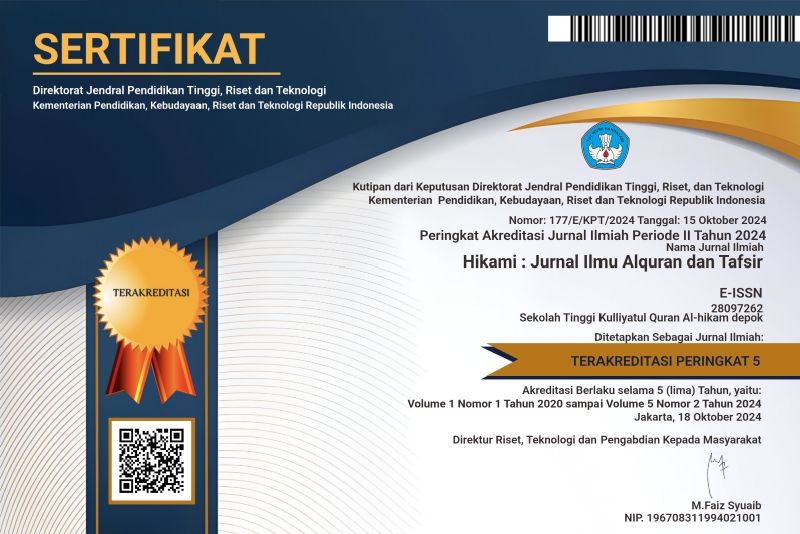
Accreditation Certificate
Latest publications
Tools
TOOLS
Visitors and statcounter
VISITORS
Statistic Counter

HIKAMI: Journal of Qur’anic Studies and Tafsir is a scholarly journal published by the Department of Qur’anic Sciences and Tafsir. The journal serves as an academic platform for readers, researchers, scholars, and practitioners who seek to explore, understand, develop, and implement studies related to the Qur’an and Tafsir from interdisciplinary and contemporary perspectives.
HIKAMI publishes original research articles, conceptual papers, and critical studies in the field of Qur’anic studies and Qur’anic exegesis (tafsir). The journal aims to contribute to the advancement of academic discourse by promoting rigorous, ethical, and innovative scholarship.
The scope of the journal includes, but is not limited to, the following areas:
HIKAMI welcomes contributions from scholars and researchers worldwide and encourages interdisciplinary approaches that enrich the study of the Qur’an and Tafsir.