Submit Article
Template
Indexed By




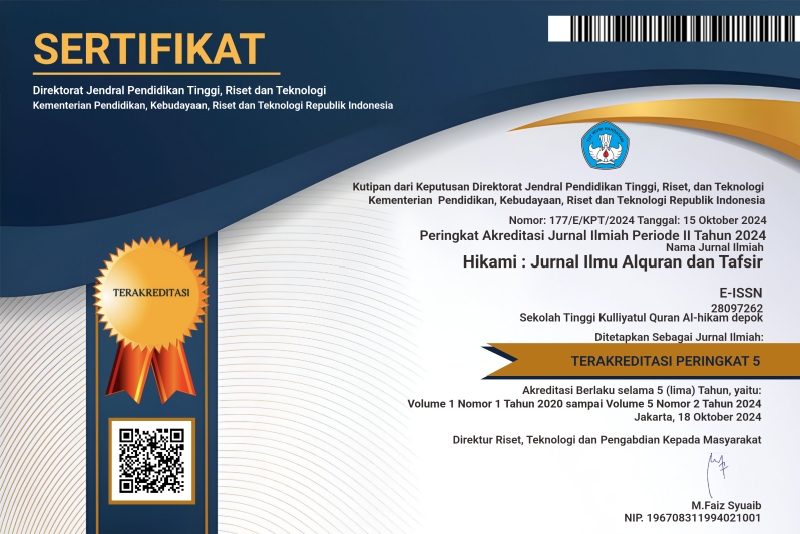
Accreditation Certificate
ISSN
Latest publications
Tools
TOOLS
HIKAMI: Jurnal Ilmu Alquran dan Tafsir is committed to maintaining the accuracy, transparency, and integrity of the scholarly record. The journal recognizes that errors may occasionally be identified after an article has been published and that concerns may arise regarding the reliability, originality, or ethical integrity of published research.
In accordance with the principles of publication ethics and the guidelines of the Committee on Publication Ethics (COPE), HIKAMI adopts procedures for issuing corrections, expressions of concern, and retractions when necessary.
A correction may be published when an error is identified in a published article and the correction is necessary to maintain the accuracy and integrity of the scholarly record, while the main findings and conclusions remain reliable.
Corrections may address, but are not limited to:
Errors in factual information, data presentation, references, or other substantive details.
Errors in author names, institutional affiliations, or author contribution statements.
Errors introduced during the editorial or production process.
Omissions or inaccuracies that may mislead readers but do not invalidate the principal findings or conclusions of the article.
Authors who identify an error in their published work should promptly notify the editorial office of HIKAMI and provide a clear explanation of the error and the proposed correction.
The editorial team will evaluate the request and determine whether a formal correction notice is necessary. Where appropriate, the correction notice will describe the error, specify the changes made, and provide a direct link to the original article.
Corrections will be published as transparently as possible and linked to the original publication to ensure that readers can identify the corrected information.
Retraction is a mechanism for correcting the scholarly record when a published article contains serious problems that undermine the reliability of its findings, arguments, or conclusions, or when significant publication ethics violations have been established.
HIKAMI may consider retracting an article under circumstances including, but not limited to:
Clear evidence that the findings or conclusions are unreliable as a result of major errors, data fabrication, falsification, or other forms of misrepresentation.
Substantial plagiarism or duplicate publication without appropriate acknowledgment, permission, or justification.
Unauthorized use of research materials, data, or other intellectual property.
Serious violations of research or publication ethics.
Evidence that the publication was based on a compromised or manipulated peer-review process.
Undisclosed competing interests that materially compromise the integrity or interpretation of the published work.
Other serious legal, ethical, or scholarly concerns that substantially undermine the credibility of the article.
Retraction decisions will be based on an appropriate assessment of the available evidence. The purpose of retraction is to correct the scholarly record and protect readers, rather than to punish authors.
When a potential reason for retraction is identified, HIKAMI will follow a fair, transparent, and evidence-based procedure.
Initial assessment: The Editor-in-Chief or a designated editor will assess the reported concern and determine whether further investigation is warranted.
Communication with authors: The corresponding author and, where appropriate, the co-authors will be informed of the concerns and given an opportunity to provide an explanation and relevant supporting evidence.
Further investigation: The editorial team may consult independent experts, peer reviewers, the journal's editorial board, or the relevant author's institution when necessary. Editors will also consider potential conflicts of interest during the investigation.
Editorial decision: Following an assessment of the available evidence, the Editor-in-Chief will determine whether a correction, an expression of concern, a retraction, or another appropriate action is warranted.
Publication of notice: When retraction is necessary, HIKAMI will publish a clear retraction notice explaining the reasons for the decision and identifying the affected article. The notice will be linked to the original publication and made freely accessible to readers.
The journal may proceed with an appropriate editorial action even if some or all authors disagree with the decision, provided that the decision is supported by sufficient evidence and follows a fair procedure.
When substantial concerns have been raised about a published article but the available evidence is inconclusive, or when an investigation is ongoing and a timely resolution is not possible, HIKAMI may publish an Expression of Concern.
An expression of concern serves to alert readers to unresolved issues that may affect confidence in the article. It is an interim measure and does not, by itself, constitute a final determination of misconduct.
Following the completion of an investigation or the emergence of further evidence, the journal may issue a correction, retract the article, or publish an additional notice explaining the outcome.
HIKAMI is committed to ensuring that corrections and retractions are clearly documented and traceable.
Correction and retraction notices will identify the affected article by its title, author names, and DOI, where available.
Each notice will explain the nature and reason for the correction or retraction in clear and objective language.
Notices will be directly linked to the original article and made freely accessible.
Retracted articles will normally remain available online but will be clearly marked as “Retracted” to prevent readers from mistaking them for valid, unaffected publications.
The journal will update relevant publication records and metadata, including DOI and indexing records where applicable, to reflect the correction or retraction.
Removal of an article from the online record will be considered only in exceptional circumstances, such as serious privacy violations, legal requirements, or other compelling circumstances. Where removal is necessary, the journal will preserve appropriate bibliographic information and provide an explanation whenever legally permissible.
Authors are responsible for promptly informing the journal of significant errors identified in their published articles and for cooperating with reasonable requests for clarification or supporting evidence.
The editorial team is responsible for evaluating reported concerns impartially, protecting the confidentiality of investigations where appropriate, providing authors with a fair opportunity to respond, and taking action proportionate to the evidence.
HIKAMI will handle all cases in accordance with the principles of editorial independence, transparency, fairness, and publication ethics.
This policy is guided by the principles and recommendations of the Committee on Publication Ethics (COPE), particularly its guidance on retractions and the correction of the scholarly record.
For further information, please consult the COPE website.