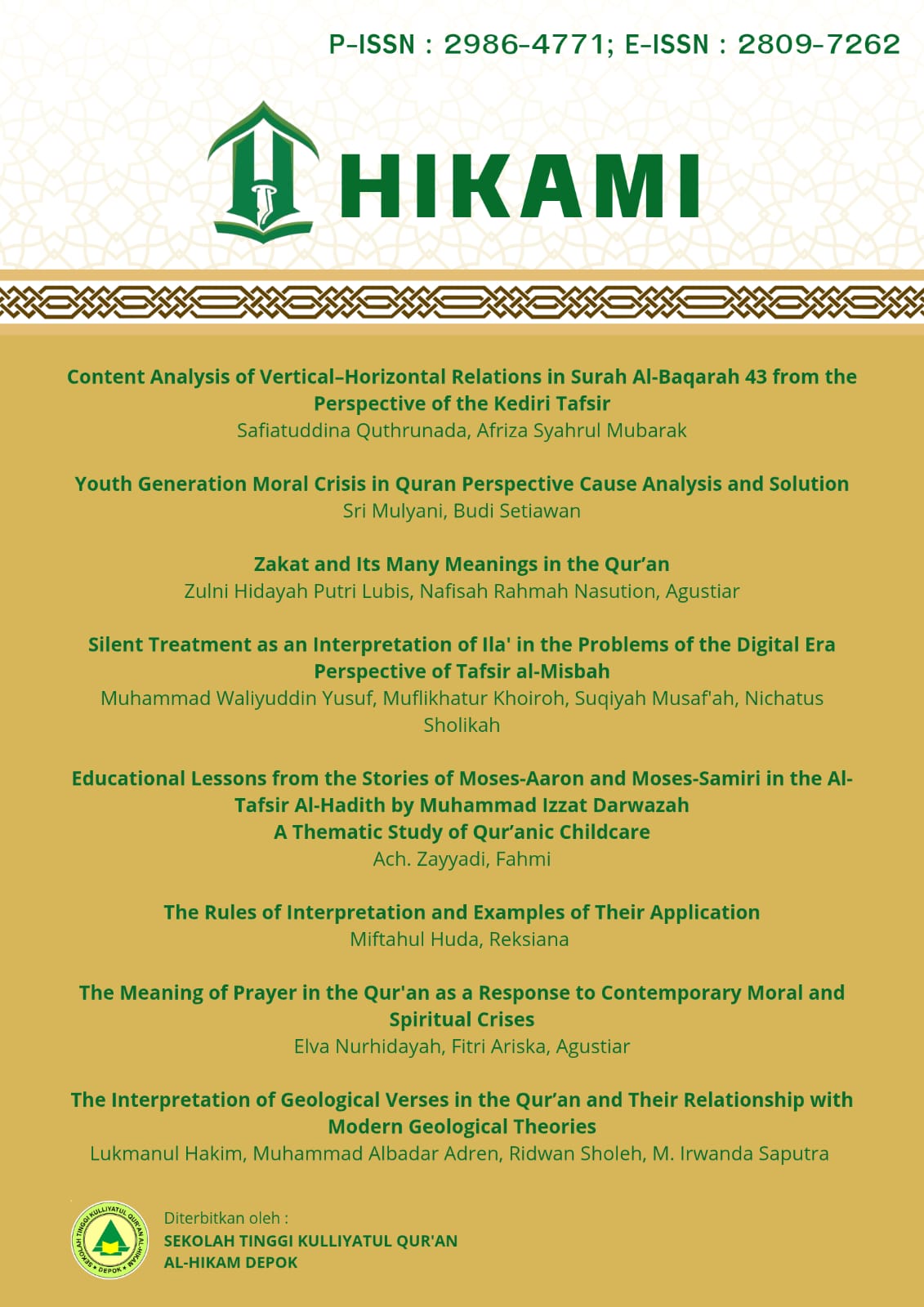
The Interpretation of Geological Verses in the Qur’an and Their Relationship with Modern Geological Theories
Keywords:
Scientific exegesis, Modern geology, Earth dynamics, Cosmic versesAbstract
This study discusses the relationship between the Qur’anic verses and modern geology through a scientific exegesis approach. The background of this research stems from the belief that the Qur’an not only contains moral and spiritual guidance but also reflects scientific principles that can be revealed through contextual interpretation. The main objective of this study is to explain the harmony between the Qur’an’s explanations of natural phenomena and modern geological theories such as the earth’s equilibrium, the formation of mountains, and the dynamics of the earth’s crust. The method used is a qualitative descriptive analysis of the interpretations of Hasbi Ash-Shiddieqy, Sayyid Quthb, and M. Quraish Shihab on three verses, namely QS. An-Nahl [16]:15, QS. Ar-Ra‘d [13]:3, and QS. Adz-Dzariyat [51]:47–48. The results of the study indicate that the concept of mountains as stabilizers of the earth, the continuous process of land formation, and the expansive motion of the universe reflect the compatibility between the revealed text and modern geological principles. In conclusion, the Qur’an implicitly contains scientific values that support the understanding of natural laws and reinforce the view that revelation and science complement each other. This research contributes to enriching scientific exegesis studies and encourages synergy between religious knowledge and modern science to build an integrative understanding of God’s creation.
References
a. Book:
Ash-Shiddieqy, H. (1956). Tafsir Al-Qur’anul Majid An-Nur. Jakarta: Bulan Bintang.
Keller, E. A., & DeVecchio, D. E. (2021). Introduction to Earth Materials and Systems. Physical Geology Today.
Noor, D. (2009). Pengantar Geologi. Bandung: No publisher.
Press, F., & Siever, R. (1986). Earth: An Introduction to Physical Geology. New York: W.H. Freeman.
Qutb, S. (1980). F? ?il?l al-Qur’?n (Vol. 9). Cairo: D?r al-Syur?q.
Qutb, S. (2003). F? ?il?l al-Qur’?n. Beirut: Dar al-Syuruq.
Shihab, M. Q. (2002). Tafsir Al-Mishbah (Vol. 10; Vol. 13). Jakarta: Lentera Hati.
Shihab, M. Q. (2021). Tafsir Al-Mishbah: Messages, Impressions, and the Harmony of the Qur’an. Jakarta: Lentera Hati.
Tarbuck, E. J., & Lutgens, F. K. (2018). Earth Science. Pearson.
Tarbuck, E. J., Lutgens, F. K., & Tasa, D. (2021). Internal Processes of the Earth and Their Surface Expressions. Earth Science Review.
Zuhdi, M. (2019). Textbook: Introduction to Geology. Yogyakarta: Duta Pustaka Ilmu.
b. Journal article:
Abdullah, F. (2024). Scientific miracle in the field of geology (Earth dynamics in the verses of the Qur’an). MAGHZA: Journal of Qur’anic Studies and Tafsir.
Carlson, R. W. (2021). Cosmochemical foundations of Earth’s early geodynamics. Annual Review of Earth and Planetary Sciences.
Clery, D. (2020). Big Bang chemistry: How cosmic expansion formed the building blocks of Earth. Nature Astronomy.
Dunnett, K., Wilson, P., & Ford, M. (2024). Interdisciplinary reassessment of isostatic theory in modern geodynamics. Earth-Science Reviews.
Lamb, S., Stern, T., & Smith, E. (2020). Global whole-lithosphere isostasy and the elevation of continents. Geological Society of London Special Publications.
Marshak, S. (2020). Surface processes and landscape evolution. Journal of Geoscience Education.
Montgomery, D. R. (2022). Physical geology and environmental hazards. Annual Review of Earth and Planetary Sciences.
Peebles, P. J. E. (2021). Cosmology and the foundations of planetary materials. Annual Review of Astronomy and Astrophysics.
Pilchin, A. N., & Eppelbaum, L. V. (2020). Plate tectonics and Earth evolution: A conceptual review. Transactions of Earth Sciences.
Schiffer, C., Petersen, K., & Fullea, J. (2023). The architecture of the Moho and its role in lithospheric isostasy. Journal of Geophysical Research: Solid Earth.
Watts, A. B. (2023). Lithospheric flexure and the principles of isostasy revisited. Cambridge Earth Sciences Review.
Zaini, M., Wahid, M. A., & Hamdan, A. M. (2020). The Qur’an and modern geoscience: Part I. Elkawnie: Journal of Islamic Science and Technology.
c. Book chapter:
Hubble, E. (1929). A relation between distance and radial velocity among extra-galactic nebulae. Proceedings of the National Academy of Sciences.
(Note: Listed separately as a classical and historically significant work in astronomy.)
Published
Issue
Section

This work is licensed under a Creative Commons Attribution-ShareAlike 4.0 International License.