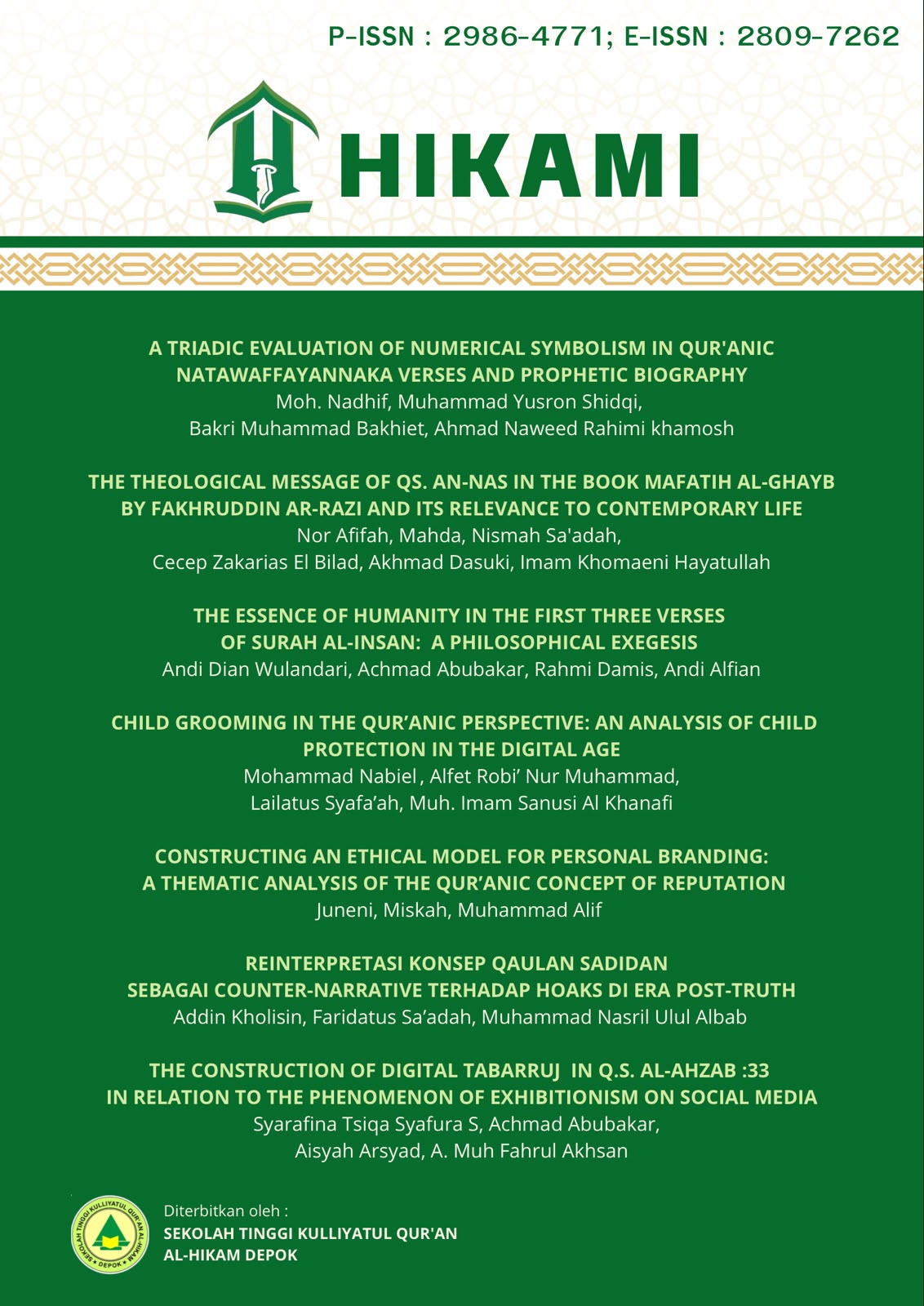
A TRIADIC EVALUATION OF NUMERICAL SYMBOLISM IN QUR'ANIC NATAWAFFAYANNAKA VERSES AND PROPHETIC BIOGRAPHY
Keywords:
cognitive bias, i‘jaz ‘adadi, natawaffayannaka, numerical symbolismAbstract
This article examines numerical symbolism in three Qur'anic verses that contain the phrase natawaffayannaka, namely QS. Yunus 10:46, QS. ar-Ra‘d 13:40, and QS. Ghafir 40:77. The study responds to a methodological problem in numerical i‘jaz research. Some studies treat numerical patterns as direct proof of divine design, while others reject them as arbitrary coincidence. Both positions often ignore the need for a transparent evaluative frame. This study uses a qualitative textual design supported by numerical-conceptual evaluation. It combines close reading, bounded numerical mapping, illustrative probability baselines, and cognitive-epistemological critique. The findings show that the surah sequence 10, 13, and 40 can be read as a cautious symbolic alignment with three common markers in the Prophet Muhammad's biography: the ten-year Medinan period, the thirteen-year Meccan mission, and the age of forty at the beginning of revelation. Yet statistical rarity does not prove intentionality. The pattern gains scholarly value only when it passes three checks: textual coherence, numerical transparency, and cognitive caution against post hoc pattern recognition. The article therefore proposes a triadic evaluation model for studying numerical symbolism in Qur'anic texts
References
Abdel Haleem, M. A. S. (2004). The Qur'an: A new translation. Oxford University Press.
Adren, M. A., Hakim, L., Sholeh, R., & Saputra, M. I. (2025). The interpretation of geological verses in the Qur'an and their relationship with modern geological theories. Hikami: Jurnal Ilmu Alquran dan Tafsir, 6(2), 97-106. https://doi.org/10.59622/jiat.v6i2.194
Al-Razi, F. al-Din. (n.d.). Mafatih al-ghayb. Dar Ihya' al-Turath al-'Arabi.
Al-Suyuti, J. al-Din. (n.d.). Al-Itqan fi 'ulum al-Qur'an. Dar al-Kutub al-'Ilmiyyah.
Al-Zarkashi, B. al-Din. (1957). Al-Burhan fi 'ulum al-Qur'an. Dar Ihya' al-Kutub al-'Arabiyyah.
Andrean, M., & Harahap, M. I. (2025). Artificial intelligence and Qur'anic interpretation: A critical comparative study of ChatGPT and classical tafsir. Al-Fahmu: Jurnal Ilmu Al-Qur'an dan Tafsir, 4(2), 658-670. https://doi.org/10.58363/alfahmu.v4i2.641
Arifin, S., & Wijaya, S. (2024). Kajian al-wujuh wa al-nazha'ir: Analisis term dhalal dalam Al-Qur'an. Hikami: Jurnal Ilmu Alquran dan Tafsir, 5(1), 33-54. https://doi.org/10.59622/jiat.v5i1.112
Ayuni, W., Nirwana, A., & Nurrohim, A. (2023). Bibliometric analysis of the development map and research trends in Qur'anic studies and tafseer: A Scopus database exploration (1974-2023). Journal of Qur'an and Hadith Studies, 12(2). https://doi.org/10.15408/quhas.v12i2.36191
Bender, E. M., Gebru, T., McMillan-Major, A., & Shmitchell, S. (2021). On the dangers of stochastic parrots: Can language models be too big? Proceedings of the 2021 ACM Conference on Fairness, Accountability, and Transparency, 610-623. https://doi.org/10.1145/3442188.3445922
Brugger, P. (2001). From haunted brain to haunted science: A cognitive neuroscience view of paranormal and pseudoscientific thought. In J. Houran & R. Lange (Eds.), Hauntings and poltergeists: Multidisciplinary perspectives (pp. 195-213). McFarland.
Calis, H. (2022). The theoretical foundations of contextual interpretation of the Qur'an in Islamic theological schools and philosophical Sufism. Religions, 13(2), Article 188. https://doi.org/10.3390/rel13020188
Campanini, M. (2011). The Qur'an: The basics. Routledge.
Chamankhah, L. (2023). Tafsir or ta'wil? The Shaykhi contribution to the Qur'anic tradition of nineteenth-century Iran. The Muslim World, 113(3), 228-241. https://doi.org/10.1111/muwo.12468
Creswell, J. W.,-century Iran. The Muslim World, 113(3), 228-241. https://doi.org/10.1111/mu & Plano Clark, V. L. (2018). Designing and conducting mixed methods research (3rd ed.). SAGE.
ElKomy, M., & Sarhan, A. M. (2022). TCE at Qur'an QA 2022: Arabic language question answering over Holy Qur'an using a post-processed ensemble of BERT-based models. arXiv. https://arxiv.org/abs/2206.01550
Gelman, A., & Loken, E. (2014). The statistical crisis in science. American Scientist, 102(6), 460-465. https://doi.org/10.1511/2014.111.460
González Martínez, A. (2025). A computational system to handle the orthographic layer of tajwid in contemporary Qur'anic orthography. arXiv. https://arxiv.org/abs/2505.11379
Good, I. J. (2005). Probability and the weighing of evidence. Dover Publications. Original work published 1950.
Hamdi, T. T., Musafa'ah, S., & Hasanah, R. (2025). Mu'tazilah and the digital era: Reinterpreting Islamic tafsir in the era of artificial intelligence (AI). Jurnal Semiotika-Q: Kajian Ilmu al-Quran dan Tafsir, 5(1), 1-16.
Huda, M., & Reksiana. (2025). The rules of interpretation and examples of their application. Hikami: Jurnal Ilmu Alquran dan Tafsir, 6(2), 68-86. https://doi.org/10.59622/jiat.v6i2.162
Ibn Kathir, I. (n.d.). Tafsir al-Qur'an al-'Azim. Dar al-Kutub al-'Ilmiyyah.
Kahneman, D. (2011). Thinking, fast and slow. Farrar, Straus and Giroux.
Kerr, N. L. (1998). HARKing: Hypothesizing after the results are known. Personality and Social Psychology Review, 2(3), 196-217. https://doi.org/10.1207/s15327957pspr0203_4
Khalifa, R. (1973). The computer speaks: God's message to the world. Renaissance Productions.
Khalifa, R. (1981). Qur'an: The final testament. Islamic Productions.
Lund, B. D., Wang, T., Mannuru, N. R., Nie, B., Shimray, S., & Wang, Z. (2023). ChatGPT and a new academic reality: Artificial intelligence-written research papers and the ethics of large language models in scholarly publishing. Journal of the Association for Information Science and Technology, 74(5), 570-581. https://doi.org/10.1002/asi.24750
Mauluddin, M. (2024). Kontribusi artificial intelligence (AI) pada studi Al Quran di era digital: Peluang dan tantangan. Madinah: Jurnal Studi Islam, 11(1), 99-113. https://doi.org/10.58518/madinah.v11i1.2518
Neuwirth, A. (2019). The Qur'an and late antiquity: A shared heritage. Oxford University Press.
Nirwana AN, A., Mahmudulhassan, Ali, M., Muthoifin, Waston, & Senathirajah, A. R. S. (2024). The intersection of Quranic studies and modern technology: A bibliometric analysis of academic publications from 2000 to 2024. Qubahan Academic Journal, 4(4), 178-190. https://doi.org/10.48161/qaj.v4n4a981
Nugraha, A. D. (2024). Analisis penafsiran al-ahruf al-muqatha'ah dalam Al-Qur'an perspektif Tafsir Turjuman Al-Mustafid. Hikami: Jurnal Ilmu Alquran dan Tafsir, 5(1), 63-70. https://doi.org/10.59622/jiat.v5i1.114
Patel, S., Kane, H., & Patel, R. (2023). Building domain-specific LLMs faithful to the Islamic worldview: Mirage or technical possibility? arXiv. https://arxiv.org/abs/2312.06652
Quthrunada, S., & Mubarak, A. S. (2025). Content analysis of vertical-horizontal relations in Surah Al-Baqarah 43 from the perspective of the Kediri Tafsir. Hikami: Jurnal Ilmu Alquran dan Tafsir, 6(2), 1-13. https://doi.org/10.59622/jiat.v6i2.174
Reynolds, G. S. (2018). The Qur'an and the Bible: Text and commentary. Yale University Press.
Shahid, U., Hussain, M. Z., & Sayers, W. (2025). Computational analysis of Quran text using machine learning and large language models. In 2025 8th International Conference on Data Science and Machine Learning Applications (CDMA). IEEE. https://doi.org/10.1109/CDMA61895.2025.00009
Shermer, M. (2008). Patternicity: Finding meaningful patterns in meaningless noise. Scientific American, 299(5), 48-55.
Simmons, J. P., Nelson, L. D., & Simonsohn, U. (2011). False-positive psychology: Undisclosed flexibility in data collection and analysis allows presenting anything as significant. Psychological Science, 22(11), 1359-1366. https://doi.org/10.1177/0956797611417632
Sinai, N. (2017). The Qur'an: A historical-critical introduction. Edinburgh University Press.
Wahid, S. H. (2024). Exploring the intersection of Islam and digital technology: A bibliometric analysis. Social Sciences & Humanities Open, 10, Article 101085. https://doi.org/10.1016/j.ssaho.2024.101085
Witztum, D., Rips, E., & Rosenberg, Y. (1994). Equidistant letter sequences in the Book of Genesis. Statistical Science, 9(3), 429-438. https://doi.org/10.1214/ss/1177010393
Zaid, B., Fedtke, J., Shin, D. D., El Kadoussi, A., & Ibahrine, M. (2022). Digital Islam and Muslim millennials: How social media influencers reimagine religious authority and Islamic practices. Religions, 13(4), Article 335. https://doi.org/10.3390/rel13040335
Published
Issue
Section

This work is licensed under a Creative Commons Attribution-ShareAlike 4.0 International License.